Carpenter in Paterson, NJ: Wood Rot, Structure & Finish Work
Homeowners searching for a carpenter near me in Paterson, Clifton, Fair Lawn, Hawthorne and surrounding areas turn to Paterson Carpentry for work that ranges from wood rot and termite damage repair to structural framing and finish carpentry. We work on the full span of residential carpentry: the decay that advances from sills and fascia, the structural members that need sistering or replacement, the framing that goes into walls and floors, and the trim, doors, cabinets and built-ins that finish a room. This is the building stock we know, the brick-and-frame two- and three-family houses that fill Riverside and Sandy Hill, the Colonials and Capes climbing toward Haledon, the Queen Anne homes on the Eastside, and the post-war singles and split-levels across the surrounding towns. These houses have settled over a century or more, and the climate here, freeze-thaw cycles, heavy wet snow, humid summers and occasional river flooding, puts steady pressure on wood framing close to grade and on exterior surfaces that face the weather.
What sets us apart is that the same carpenters do the work, not a rotating crew dispatched from a call center. We explain what has failed and why, and we propose repair before replacement whenever the wood justifies it. If you have noticed soft spots in your deck, a floor that feels bouncy underfoot, rot in your siding or fascia, or damage found during a pest inspection, call (862) 282-1733 or request a free wood rot inspection to get an honest assessment.
Why Wood Fails in Paterson, and How We Read It
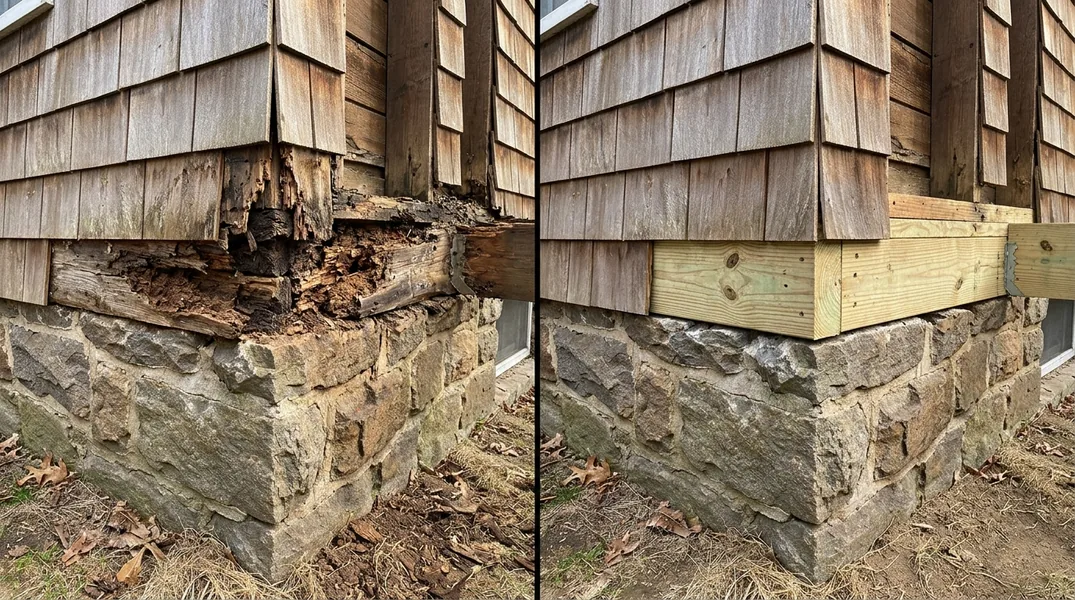
Wood fails here in predictable ways, and understanding why matters when you are deciding what to do about it. Dry rot is not a wet-rot pathology, it is a fungus that requires sustained moisture, not standing water or spray. In Paterson and the surrounding area, that moisture comes from the climate itself: freeze-thaw cycles that open joints and drive water into end grain, heavy wet snow that soaks fascia and soffits for weeks at a time, humid summers that swell wood and trap moisture, and the occasional river flood that saturates basements and first-floor framing in low neighborhoods. Wood sills sitting close to grade, window sills that collect runoff, deck ledgers fastened to the rim joist, and porch posts rooted in damp earth are the places where this fungus takes hold. Wet rot settles into thresholds, under door frames, and anywhere water pools rather than sheds. The wood softens from the inside out, and often the painted surface stays sound even as the member loses its section.
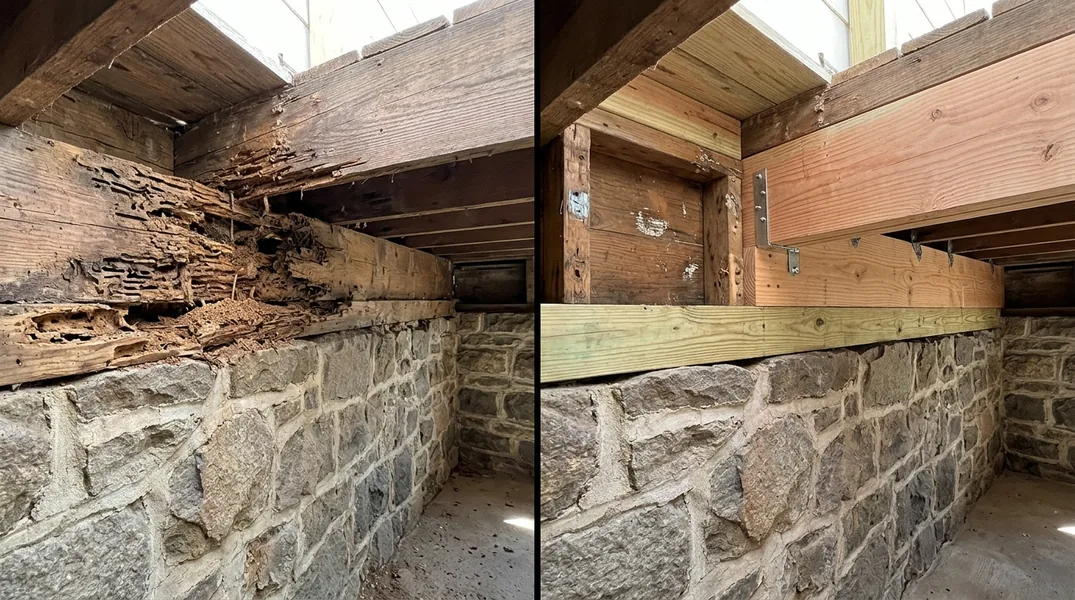
Eastern subterranean termites and wood-boring beetles hollow framing members from within, leaving the paint film intact while the interior becomes a lattice of galleries. You find this damage when a pest inspection report comes back, or when a probe goes through what looked like solid wood. Our job is to repair and replace the damaged framing, working from your own pest inspection report. We do not treat, fumigate, or perform pest control, that is a separate regulated trade, and it is not our scope. What we do is cut out the damaged section if it is small and the member is otherwise sound, or replace the entire member if it has lost too much section to be safe.
The honest assessment comes down to three things: how much sound wood is left, whether you can close the water path that fed the decay, and what the two options cost. A probe tells us where sound wood begins. We check the framing behind the visible surface and trace the water source. If the decay is cosmetic and the member is solid, we can cut it out and rebuild the section with new wood. If the member has lost its structural section, replacement is the answer. And if the water source is still open, a gutter that does not drain, a deck ledger fastened without flashing, a sill without a capillary break, the repair fails again. Filler over rot is not a repair. Call (862) 282-1733 to have us look at it, or learn more about wood rot and dry rot repair and how we approach termite damage repair.
Structural Carpentry in Paterson: Joists, Beams and Settling
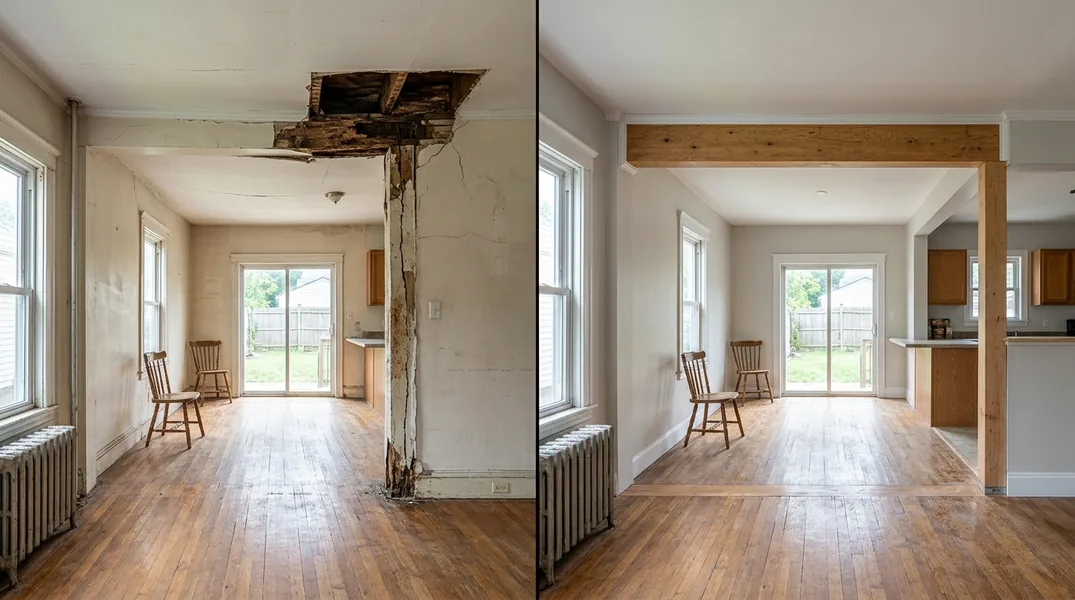
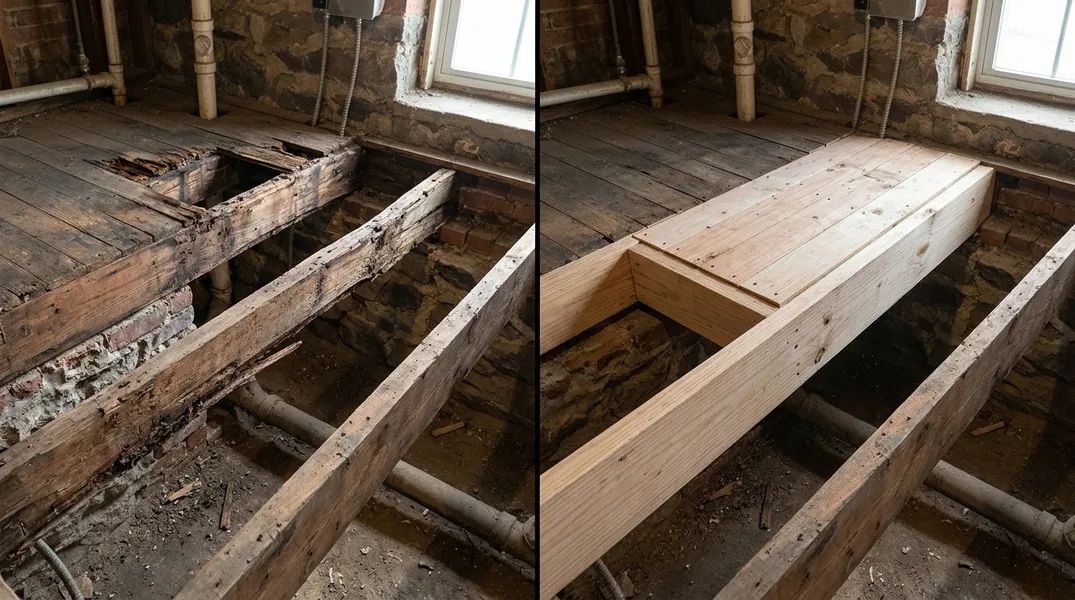
A sloping floor in a house built in the 1890s or 1920s is usually not an emergency, it is the normal condition after a century of settling. What matters is whether the house is still moving and whether the structural members are doing their job. We assess that by probing the sill plate and rim joist where they sit on the foundation, checking the floor joists for soft spots or active decay, and looking at how the beams are bearing. If a floor joist is cracked but still sound, we can sister it with new wood bolted alongside. If a section of subfloor has gone soft, we cut it out and replace it. If the sill plate has rotted, we replace the damaged section. If a beam has sagged or failed, we install a new beam and shore the floor while the work is in progress. Load-bearing walls that need to be removed, or headers that need to be replaced, commonly require a licensed structural engineer to size the beam and a permit from your local building department. We build to those engineered drawings rather than produce them. Floor joist and subfloor repair, beam replacement and load-bearing wall removal, and structural framing carpentry are all within our scope when the design is in hand.
Sticking doors and out-of-plumb walls in old houses are usually settling, not active failure. The brick-and-frame houses that fill Riverside, the Colonials on the slopes toward Haledon, and the older stock throughout the city have moved and will continue to move very slowly as they age. The question is not whether they have settled, they have, but whether that settling has stopped and whether the structure is sound. We look at that with a level and a probe, and we tell you plainly what we find.
Finish Carpentry and Built-Ins in Paterson Homes
Finish carpentry in this housing stock is as much about matching what is already there as it is about building new. The bay windows, compact floor plans and out-of-square openings that are standard in Paterson's pre-war houses demand casing that is scribed to fit, baseboard that runs true even where the wall is not plumb, and crown molding installed with coped joints rather than caulked corners. We match existing period profiles, set consistent reveals, and work with walls that have settled and shifted. Crown molding and baseboard installation, wainscoting, custom built-ins and shelving, and interior door installation and repair are all work where the craft matters, where a coped joint holds better than caulk, and where scribing to an existing wall means the trim sits flush and looks right.
We also handle cabinet and vanity installation, stair and railing repair, and exterior and entry door installation. In houses where the original millwork is worth keeping, we restore and match it. Where it is gone, we install new trim that fits the period and the space. The work is visible and durable when it is done right.
Permits, Repair-or-Replace & What We Do Not Do
A permit is commonly required for structural work such as removing or altering a load-bearing wall, replacing beams or joists, and installing or modifying stairs and railings. Requirements vary by jurisdiction and by the scope of work. In most cases, you will need to verify with your local building department whether a permit applies to your project, what the process is, and what documentation is needed. We can help you understand what the work involves, but the permit itself is between you and the building department. On the repair-or-replace question, the decision hinges on three factors: how much sound section the member has left, whether the water source that caused the decay can be closed, and what each option costs. We quote both when both are real options, and we explain the trade-offs plainly.
We are fully insured and can help you document damage for an insurance claim, though we cannot promise that a claim will be approved or that work will be covered. If you are working with a pest inspector, bring their report to your estimate so we can see exactly what they found and where. We repair and replace wood damaged by insects, we do not treat, fumigate, or perform pest control, which is a separate regulated trade. Requirements vary, and requirements for engineering, permitting and compliance differ from one jurisdiction to another. Always verify with the Paterson building department before starting your project. Call (862) 282-1733 or contact us for an estimate.