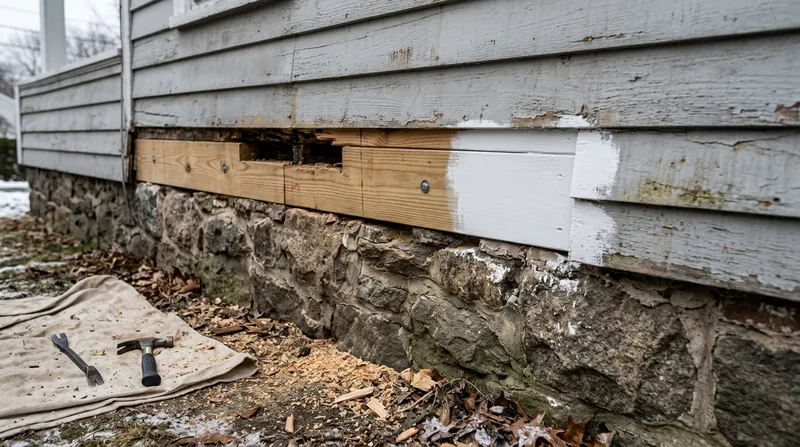




Paterson's two-family frame houses, Eastside Park Victorians, and post-war colonials sit on fieldstone and brick basements with wood sills close to grade, wrapped by the Passaic River and exposed to freeze-thaw winters, ice dams, nor'easter rain, and humid summers that feed wood decay. Wood Rot and Dry Rot Repair in Paterson is the most common structural carpentry call we get because the climate, terrain, and age of the housing stock guarantee it. Decayed sills, rim joists, fascia, soffit, and porch framing fail predictably in this environment. We cut out the soft wood, treat the sound wood around it, and rebuild with rot-resistant lumber. That is a permanent repair, not a cosmetic patch or a band-aid that fails again in five years.
Why Wood Rot and Dry Rot Repair Matter in Paterson's Historic Housing Stock
Paterson's neighborhoods are defined by their wood-frame houses: silk-mill worker cottages in Dublin and the Riverside, stacked porches on two- and three-family homes climbing Sandy Hill and People's Park, Queen Anne and Shingle-style homes on the Eastside, and colonials and capes spreading toward Haledon and Clifton. Most were built between 1890 and 1950. They sit on basements with wood sill plates and rim joists exposed to moisture rising from the earth, damp basements after heavy rain and Passaic River flooding, and freeze-thaw cycles that crack mortar joints and drive water into end grain. Wood rot begins quietly and spreads fast once it starts.
- Sill plates and rim joists decay from ground moisture and ice-dam backup, weakening the foundation connection and causing floors to sag or settle unevenly.
- Fascia and soffit rot from backed-up gutters and ice dams, opening the wall cavity to water infiltration that spreads rot into the framing behind.
- Porch posts and beams fail from standing water, poor drainage, and repeated wet-freeze cycles, making porches unsafe and compromising the house structure.
- Exterior siding and trim rot from nor'easter exposure and paint failure, exposing studs and sheathing to accelerated decay.
Catching rot early and cutting it out stops the spread. Waiting costs you floor joists, beams, and load-bearing walls.
Key info: A sill plate that has lost 30 percent of its cross-section to decay can no longer carry the floor load safely. We replace it in place, sistering new lumber alongside the sound wood, or cutting out the rotten section and splicing in rot-resistant lumber. The choice depends on the extent of decay and the load above it. This work often needs a permit, especially if the house is in a historic district like Eastside Park or if the repair is load-bearing. Check with your local Paterson building department to confirm.
See also Floor Joist and Subfloor Repair if you have sagging floors or soft spots in your basement.
How We Repair Wood Rot and Dry Rot in Paterson: Our Process
We start with a site visit to identify the decay, trace it to its source, and assess whether repair or replacement is the honest answer. We photograph the damage, document what we find, and explain what caused it so you understand why it happened and how to prevent it next time. Once you approve the scope, we remove the decayed wood, treat the sound wood around it with a wood preservative, and rebuild with pressure-treated lumber or naturally rot-resistant species like redwood or cedar, depending on the location and your budget. The repair is permanent.
- We assess the decay depth and extent using a probe and visual inspection to determine whether the member can be repaired or must be replaced.
- We identify and address the moisture source, whether it is a leaking gutter, poor grading, a backed-up downspout, or capillary rise from the basement.
- We cut out all soft wood and treat the remaining sound wood with a penetrating wood preservative to arrest any incipient decay.
- We rebuild using pressure-treated lumber, redwood, or cedar, sistering new members to sound wood or splicing in new sections as the damage dictates.
- We caulk and seal all joints and expose edges to shed water and prevent future moisture intrusion.
The work is done by the same carpenters on every job, not a rotating crew or franchise model. You get consistency and accountability.
Local example: A two-family home in Riverside had a rotted sill plate under the front wall. The rim joist was soft for about 18 inches, and the band board was cracked and peeling paint. We cut out the bad sill and rim joist, sistered new pressure-treated lumber alongside the sound portion, and replaced the band board in kind. We sealed the basement wall and recommended a gutter extension to direct water away from the foundation. Cost was $2,400 including materials and labor. The repair took three days. No permit was required because the structural change was localized and non-load-bearing alteration. The house is now stable and the sill will last 30 years or more.
Related service: Termite Damage Repair if you suspect eastern subterranean termites in your sill or porch posts.
| Repair Approach | Description | Best For |
|---|---|---|
| Sistering | New lumber bolted alongside sound wood, sharing the load. The original member remains in place. | Sill plates, rim joists, and floor joists with decay on one edge or face but sound core wood. |
| Splicing | The rotten section is cut out and new lumber is fitted and bolted in its place, joining the sound ends. | Sill plates, fascia, soffit, and porch beams where the decay is localized and the sound wood on each end is adequate to anchor the repair. |
| Full Replacement | The entire member is removed and replaced with new lumber. Used when decay is extensive or the member has lost more than 50 percent of its cross-section. | Load-bearing beams, rim joists, and structural posts where repair would leave insufficient strength or the cost of repair approaches the cost of replacement. |
| Preservative Treatment | Penetrating wood preservative applied to sound wood adjacent to the decay to arrest fungal activity and prevent future rot from spreading. | All repairs, as a standard step after decay removal, to protect the sound wood and extend the life of the repair. |
Wood Rot and Dry Rot Repair Cost in Paterson: What to Expect
A typical sill plate or rim joist repair in Paterson starts at $650 for a small localized decay and straightforward sistering or splice. The cost moves up with the size of the member, the extent of decay, access difficulty, and whether the repair requires a permit or structural engineer review. A full rim joist replacement on a two-family home runs $2,000 to $4,500 depending on the length and whether the basement is finished. Fascia and soffit rot repairs run $400 to $1,200. Porch post and beam repairs start at $800 and can reach $2,500 if the porch is large or the posts are load-bearing and need sistering or replacement.
Cost is driven by the extent of decay, the size of the member, access and work conditions (tight basement, finished basement, or exposed porch framing), the species and grade of replacement lumber, and whether permits and inspections are required. A job that looks like a $900 repair on the surface might cost $1,800 if the decay runs deeper than visible or if the member is load-bearing and needs engineering input. That is why getting two or three estimates from local carpenters is smart: you learn what is actually happening and what the honest range is.
We offer a free, no-obligation estimate within 24 hours. Call (862) 282-1733 or visit our pricing page for more detail on how we calculate costs for different scenarios. Travel is included in all Paterson and surrounding areas, with no separate mileage or call-out fee.
What to Look for When Hiring a Carpentry Contractor Near Me in Paterson
Hiring a carpenter for wood rot repair is a decision that affects the value and safety of your home. You want someone who understands the climate and the local housing stock, explains the problem clearly, and proposes repair before replacement. Ask any contractor you call whether they are fully insured and whether they can provide references from recent jobs in Paterson, Clifton, Passaic, or Fair Lawn. Check those references. Ask about their process for identifying the moisture source and preventing future rot. Ask whether they expect a permit and whether they have worked in historic districts or with HOA requirements.
- Verify that the contractor is fully insured and carries liability and workers compensation coverage that protects you if someone is injured on your property.
- Request references from homeowners in your area and call at least two of them to ask about the quality of the work and the contractor's professionalism and communication.
- Ask the contractor to walk you through their diagnostic process and explain what caused the rot and what will prevent it from happening again.
- Confirm whether the repair requires a permit from the Paterson building department and whether the contractor has experience pulling permits and coordinating inspections.
- If your home is in a historic district like Eastside Park or if your neighborhood has an HOA, ask whether the contractor understands any design or material restrictions that apply to exterior work.
- Get the estimate in writing, including the scope of work, materials, labor, timeline, and any assumptions about what will be found once the work begins.
The cheapest estimate is rarely the best value. A carpenter who listens, explains, and stands behind their work is worth the premium.
Ready to get started? Contact us for a free estimate, or call (862) 282-1733 to discuss your situation with a carpenter who knows Paterson.
Wood Rot & Dry Rot Repair in Paterson: Pricing Guide
| Service | Price | Details |
|---|---|---|
| Small decay repair (sill, fascia, or trim) | Starting at $650 | Localized rot removal, preservative treatment, and sistering or splice, no structural load or permit required |
| Rim joist or sill plate repair | Starting at $1,200 | Single section sistering or splice on a two-family home, includes preservative treatment and new pressure-treated lumber |
| Full rim joist or sill replacement | $2,000 to $4,500 | Complete member replacement, length-dependent, includes structural assessment and may require permit and building department inspection |
| Porch post or beam repair | Starting at $800 | Sistering or replacement of load-bearing posts and beams, depends on post size, decay depth, and whether porch is enclosed or exposed |
| Complex or multi-member job | On estimate | Extensive decay affecting multiple structural members, moisture source remediation, or load-bearing work requiring engineer review and permit |
| Free estimate | No charge | Response within 24 hours, on-site inspection, written scope and pricing, no obligation to book work |
Indicative pricing, the exact cost depends on square footage, finish, and site access. Free personalized estimate within 24h at (862) 282-1733.


