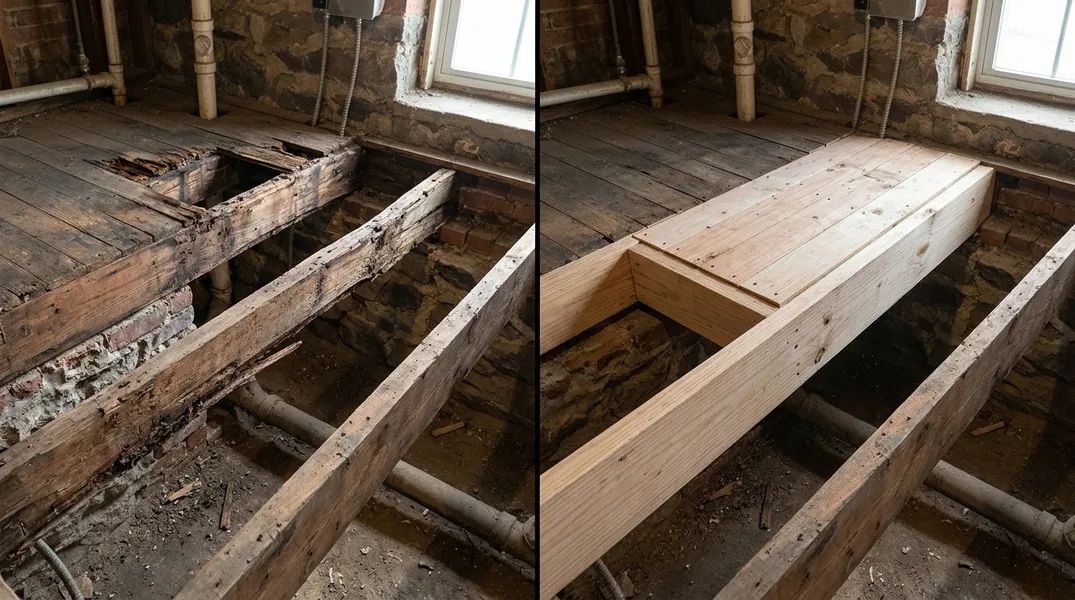
Why Is My Floor Sagging? Common Causes in Paterson Homes
If you've noticed your floors sloping or dipping in your Paterson two-family home, you're not alone. Sagging floors are one of the most common structural complaints we hear from homeowners in the area, and they're never something to ignore. The problem usually isn't cosmetic. A sagging floor is your home's way of telling you that something beneath the surface has failed or is failing.
The primary culprit behind sagging floors is damage to the floor joists, the horizontal beams that support your floors from underneath. In older Paterson two-families, these joists are often made of wood, and wood is vulnerable to several types of deterioration. Wood Rot & Dry Rot Repair is frequently necessary because moisture intrusion causes the wood to soften, lose structural integrity, and eventually fail under the weight of your home. Dry rot, in particular, spreads quickly and can compromise multiple joists before you even realize there's a problem.
Another common cause is Termite Damage Repair situations, where termites have hollowed out sections of the joists from the inside. Settlement and age also play a role. As homes settle over decades, the structural elements can shift, and if the foundation or support beams have moved, the floor above will follow. Finally, inadequate ventilation in crawl spaces or basements creates the perfect environment for moisture to accumulate, accelerating rot and weakening the wood.
Understanding Floor Joist Repair and Sistering Floor Joists
When we assess sagging floors, we're really evaluating the condition of your floor joists. Floor Joist & Subfloor Repair is often the key to restoring structural stability. The good news is that not every sagging floor requires complete joist replacement. Depending on the extent of the damage, we have several repair strategies available.
One of the most effective and cost-efficient methods is sistering floor joists. This technique involves installing a new, healthy joist alongside a damaged one and fastening them together with bolts or screws. The new joist shares the load with the remaining sound wood, effectively doubling the support capacity of that area. Sistering works best when the damage is moderate and localized to specific sections rather than throughout the entire joist. It's a solution that preserves much of the original structure while restoring function and safety.
In cases where rot or termite damage is more extensive, we may need to replace entire sections of joists or install new support beams. This is where Beam Replacement & Load-Bearing Wall Removal expertise becomes necessary. The process requires temporary support structures to safely carry the weight of your home while we work, and it demands precision to ensure the new joists are properly sized and installed according to building codes. This is definitely not a DIY project, as improper installation can create new structural problems.
Sagging Floor Repair Cost in Paterson: What to Budget
Homeowners naturally want to know the cost before committing to repairs. The truth is that sagging floor repair costs vary significantly based on the severity of the damage, the number of joists affected, and the repair method used. A simple sistering project on one or two joists might cost considerably less than a full joist replacement involving multiple beams and temporary support structures. At Paterson Carpentry, we provide transparent pricing based on a thorough inspection of your specific situation.
Minor repairs involving one or two joists typically range from $1,500 to $4,000, while more extensive projects affecting larger areas can run $5,000 to $15,000 or more. The cost also depends on whether you need additional work like addressing the moisture source, treating for rot, or reinforcing the foundation. If your sagging is caused by underlying foundation problems, that will add to the total investment. However, delaying repairs always costs more in the long run. Damage spreads, more wood fails, and what started as a manageable repair becomes a major structural overhaul.
The best way to understand your actual costs is to schedule a free estimate with our team. We'll inspect your floors, identify all problem areas, and give you a detailed breakdown of what's needed and what it will cost. Call us at (862) 282-1733 to arrange your inspection. There's no obligation, and the information you get will help you make an informed decision about your home's future.
Signs Your Floors Need Attention Right Now
Not all floor problems are immediately obvious. Some homeowners notice a visible sag or slope, while others might only hear creaking or feel a slight bounce when walking. Both are red flags. A visible dip in your floor, especially one that's noticeable to the naked eye or that makes furniture slide, indicates significant joist failure. Creaking and squeaking can sometimes be minor, but when combined with any visible sag, they suggest structural movement that needs professional evaluation.
Other warning signs include doors or windows that no longer close properly, cracks appearing in walls or ceilings, or moisture and odors in the basement or crawl space. If you see visible mold, staining, or soft spots when you press on the wood beneath your floors, those are clear indicators of rot. Don't wait for the problem to worsen. The sooner you address sagging floors, the more repair options remain available to you, and the less extensive (and expensive) the work will be.
The Inspection Process: What to Expect
When Paterson Carpentry inspects your sagging floors, we perform a comprehensive evaluation from multiple angles. We examine the joists themselves, looking for signs of rot, termite damage, or physical failure. We assess the support beams and posts that carry the weight of the floor system. We check for moisture sources, whether that's a leaking pipe, poor drainage, or inadequate ventilation. We also evaluate the foundation to determine whether settlement or movement is contributing to the sag.
This inspection process is crucial because it reveals not just what needs to be repaired, but why the problem occurred in the first place. If we don't address the root cause, the same problem will likely recur after repair. For example, if moisture is the culprit, we'll recommend ventilation improvements or drainage solutions alongside the structural repairs. Our goal is to give you a complete picture of your home's condition and a repair plan that actually solves the problem permanently.
Next Steps: Getting Your Floors Repaired
If you're concerned about sagging floors in your home, the first step is simple: reach out to Paterson Carpentry for a professional assessment. We've helped countless homeowners in the area restore their floors and regain confidence in their home's structural integrity. Our team brings decades of experience with the specific challenges that affect older two-family homes in our region, and we know how to deliver lasting repairs that meet or exceed building codes.
Contact us today at (862) 282-1733 or visit our website to request a free estimate. We'll schedule a time to inspect your floors, answer all your questions, and provide you with a clear, honest assessment of what needs to happen next. Don't let sagging floors become a bigger problem. The sooner you act, the better your outcome will be.
Looking for a professional carpentry contractor in Paterson? Paterson Carpentry responds fast for all your carpentry needs.
Get a Free QuoteOur services: Wood Rot & Dry Rot Repair · Termite Damage Repair · Floor Joist & Subfloor Repair